
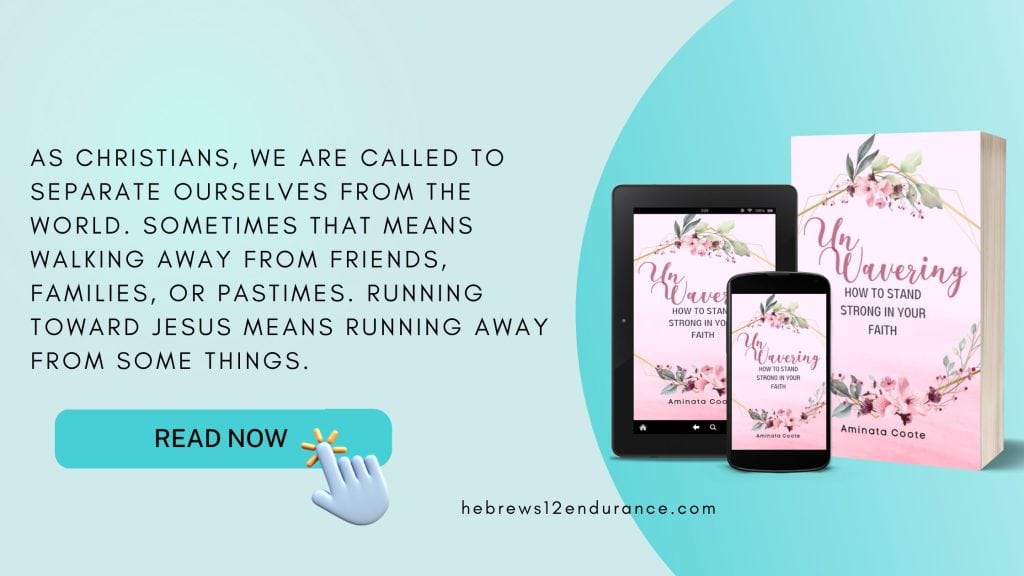
The author of Hebrews encourages us to “lay aside every weight.” Ever wondered what that means? I’m sharing a teaser from my book, Unwavering: How to Stand Strong in Your Faith, to offer some insight.
Run Naked
Table of Contents
Have you ever tried to run or walk while carrying something heavy? How fast did you move? Chances are, movement became difficult before you had covered much distance.
The writer of Hebrews encourages us to “lay aside every weight”. Let’s look at the original language so we can have a deeper understanding of his meaning.
The word translated as weight is the Greek ónkos, (pronounced ong’-kos) which could also mean a mass, burden, hindrance, or weight.
When something is a burden, it’s heavy or difficult to deal with. A hindrance is something that holds us back. Burdens and hindrances slow us down.
If you were in a race, would you want to be slowed down by the weight of things you were carrying? Or would you want to go as quickly as possible so you can cross the finish line and win the race?
In the first Olympic games, the men ran naked and carried nothing except in the hoplitodromos. I don’t believe those men ran naked because they were exhibitionists. It was because they understood the importance of getting rid of unnecessary encumbrances.
What is hindering your walk with God? Is it fear? A lack of faith? The people you associate with? Poor choices?
Whatever it is, lay it aside. God doesn’t expect us to do it alone. It’s why He gave us the Holy Spirit. During His earthly ministry, Christ showed us what was possible when we submitted wholly to God and committed to doing His work.
The Truth About Nakedness
This idea of running naked requires a bit more exploration. The first time nakedness appeared in the Bible was in Genesis 2:25:
And they were both naked, the man and his wife, and were not ashamed.
Before Adam and Eve sinned, they thought nothing of being without clothes. They cavorted in the Garden of Eden without a single care. They were unencumbered with no weight holding them back.
In their state of perfection, they didn’t need to endure because they had already crossed the finish line. Adam and Eve enjoyed the prize of an intimate, face-to-face relationship with God.
They didn’t even know they were naked until after they’d eaten from the forbidden tree. Once they had, Adam and his wife knew they were naked and became afraid.
The interesting thing is that in Hebrew, two different words are used to describe their nakedness. In Genesis 2:25, the word used was ʻârôwm, (pronounced aw-rome’) which means nude, either partially or totally, naked.
All occurrences of naked in Genesis 3 are the Hebrew word ʻêyrôm, (pronounced ay-rome’); or ʻêrôm translated nudity, naked, or nakedness.
Interestingly, both words are derivatives of ʻâram, (pronounced aw-ram’) a primitive root meaning to be or make bare. It could also have translated as being cunning (usually in a bad sense) or dealing subtilly.

Even though in English both ʻârôwm and ʻêyrôm mean naked, the connotations are different. If you look at the biblical occurrences of ʻêyrôm you’ll notice that it’s all negative. The nakedness implied by that word implies an undesirable state and, in some cases, helplessness. Here are a few instances (emphasis added):
Therefore shalt thou serve thine enemies which the LORD shall send against thee, in hunger, and in thirst, and in nakedness, and in want of all things: and he shall put a yoke of iron upon thy neck, until he have destroyed thee (Deuteronomy 28:48 KJV).
And in all thine abominations and thy whoredoms thou hast not remembered the days of thy youth, when thou wast naked and bare, and wast polluted in thy blood (Ezekiel 16:22 KJV).
And they shall deal with thee hatefully, and shall take away all thy labour, and shall leave thee naked and bare: and the nakedness of thy whoredoms shall be discovered, both thy lewdness and thy whoredoms (Ezekiel 23:29 KJV).
The connotation of ʻârôwm can be negative or positive. In Genesis 2:25, it’s used to show how free the couple was. They experienced neither shame nor fear because of their nakedness.
In Genesis 2, their nakedness symbolized their complete openness and availability to each other and God. They had nothing to hide and laid themselves bare before God and each other.
After they’d sinned, they experienced a separation from God. They could no longer stand unabashed and unashamed in His presence.
That’s why God wants us to lay aside every weight. He wants us to lay down sin, shame, fear, and anything separating us from Him. God wants us to pursue Him as He pursues us: not caring who sees or notices. He wants us to run toward Him as if we were running for a prize.
What Weight Are You Carrying?
The question each person in this race of endurance needs to ask themselves is this: What kind of weight are you carrying?
The word weight has many meanings. The Merriam-Webster online dictionary offered seventeen different meanings for the word! Let’s focus on the ones that relate to this discussion.
Weight may be defined as:
- something heavy, a load
- a heavy object used to hold or press something down or to counterbalance it
- burden, pressure
- the relative importance or authority accorded something
- measurable influence, especially on others
- overpowering force
- to oppress with a burden
- to increase in heaviness by adding an ingredient
- to cause to incline in a particular direction by manipulation
- to shift the burden of weight upon
I hope you’re beginning to see how important it is to lay aside every weight, but let’s go a little more in-depth. The weight we must set aside is anything that holds us back or prevents us from having an effective and joyful Christian life.
Yes, we will have tribulations as we follow Christ. Don’t let worldly cares and worries hamper your pursuit of Him. I don’t know about you, but sometimes I worry a lot.
I don’t always focus on who God is and instead, shift my focus to the thing I’m struggling with. Every time I do that, my walk becomes infinitely more difficult. Until I’m able to put my worry behind me, I’m unable to rejoice in the peace that comes from knowing God is always with me.
In Matthew 11:28-30, Jesus gave this invitation:
Come to Me, all you who labor and are heavy laden, and I will give you rest.
Take My yoke upon you and learn from Me, for I am gentle and lowly in heart, and you will find rest for your souls.
For My yoke is easy and My burden is light.”
The word translated as heavy laden was the Greek word phortízō, (pronounced for-tid’-zo). It also means to load up (a vessel or animal). Figuratively, it could also have been translated as to overburden with ceremony or spiritual anxiety.
The scribes and Pharisees were notorious for adding extra requirements to the commandments of God and Mosaic Law. They thought they were providing clarity and making things easier to understand. What they were really doing was making it more difficult for people to follow God. They made into a burden the Law God had given to captives set free.
The Ten Commandments and the Mosaic law were God’s gifts to the children of Israel after He had rescued them from Egyptian slavery. After over 400 years of captivity, they had to be deprogrammed from a lifestyle of idolatry and slavery.
The Law encapsulated what God expected from His people—differentiating Himself from the gods they’d known (and worshipped) in Egypt.
Jesus’ invitation in Matthew 11 was a reminder to the Israelites that God gives freedom and, as the Messiah, He could do no less. Jesus asked them to “lay aside every weight and follow Me”.
As Christians, we are called to separate ourselves from the world. Sometimes that means walking away from friends, families, or pastimes. Running toward Jesus means running away from some things. Because guess what?
Anything we put before God in our lives becomes an idol and can exert its weight on us and distract us from what’s important.
The more weight we carry, the more difficult it will be for us to run. This increases the likelihood that we’ll give up. The solution?
Run naked. Strip off anything (or anyone) that wants to weigh you down so you are better able to follow where Jesus leads.
The Big Ideas
- After sin, there was a separation between man and God. They could no longer stand unabashed and unashamed in His presence.
- The weights or burdens we carry can hamper our walk with God.
- Cast off any weights that make your quest for unwavering faith difficult.
Take Action
Identify the things that are holding you back from fully committing your life to God.

Unwavering: How to Stand Strong in Your Faith
Are you looking to boost your faith and draw closer to God?
Discover the keys to deepening your relationship with God. Life is uncertain, but you can develop the type of faith that helps you to trust God even through the hard times.
Unwavering uses biblical truth and practical advice to guide you on a transformative path to the enduring faith you crave.
Unwavering: How to Stand Strong in Your Faith was released on July 28, 2023.
